Artificial intelligence is changing quickly. Alongside the large AI platforms most people already know, a different group of tools is attracting attention: unfiltered AI, private AI, and services that place more focus on anonymity.
DIG AI sits within this wider conversation. It reflects growing interest in AI experiences that feel different from mainstream platforms, especially among users who want more privacy, fewer restrictions, or a different way to interact with artificial intelligence.
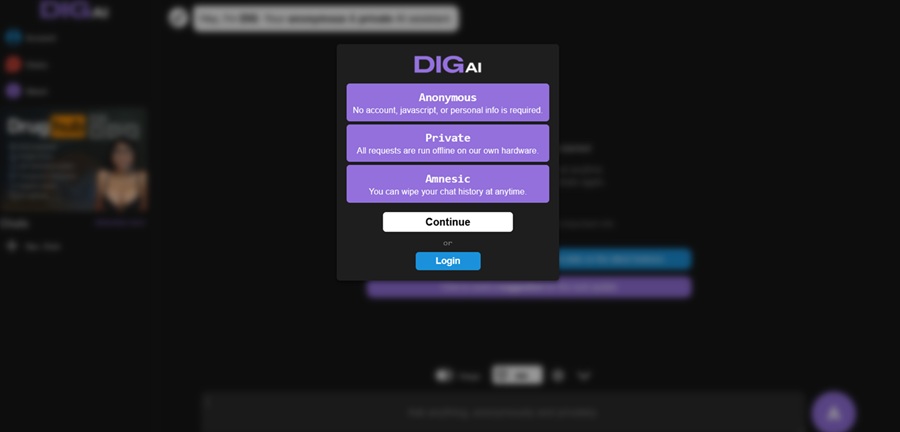
What Is DIG AI?
DIG AI can be viewed as part of the growing alternative AI space. Instead of focusing only on the biggest mainstream AI services, this space includes platforms and projects that experiment with privacy, anonymity, open access, and different approaches to AI interaction.
The idea is simple. Not every user wants the same AI experience. Some people prefer the convenience and safety controls of large commercial platforms, while others are interested in tools that give them more control over how they interact with AI.
This is one reason terms such as unfiltered AI, anonymous AI, and private AI are becoming more common in online discussions.
What Is Unfiltered AI?
Unfiltered AI generally refers to AI systems that place fewer restrictions on the types of questions or conversations they allow compared with more tightly moderated services.
The term does not describe one specific technology. Different platforms use different models, policies, safety systems, and levels of moderation. In some cases, an AI service may simply have fewer visible restrictions. In others, it may be based on an open model that users can configure themselves.
This distinction matters. "Unfiltered" does not automatically mean completely unrestricted, and it does not mean that an AI system is more accurate. It mainly describes the user's experience and the amount of moderation applied to conversations.
What Is Darkweb AI?
Darkweb AI is a broad term rather than the name of one specific type of artificial intelligence. People may use it when talking about AI tools, services, communities, or experiments associated with privacy-focused or dark-web environments.
The terms darkweb AI and unfiltered AI can sometimes appear in the same discussions, but they should not be treated as synonyms. An AI service can be private or unfiltered without operating on the dark web, and dark-web websites can host many ordinary types of content and services.
Search engines and directories focused on privacy can also help explain this wider ecosystem. For example, you can learn more about Ahmia and dark web search to understand how privacy-oriented search works.
Why Are People Interested in Anonymous AI?
Privacy is one of the biggest reasons people look for anonymous AI. Users may not want every conversation connected to their normal online identity, or they may simply prefer services that collect less personal information.
Anonymity can mean different things, however. A service might allow access without creating a traditional account, while another may reduce the amount of personal information it requests. Neither approach should automatically be treated as complete anonymity.
Users should always check the privacy policy of an AI service before sharing sensitive information. Anonymous access does not necessarily mean that conversations are never stored, logged, or processed.
Darkweb AI vs. Traditional AI Platforms
Mainstream AI platforms are usually designed around a large user base, clear policies, moderation, account systems, and a consistent product experience. Alternative AI projects can take a different approach.
Discussions around darkweb AI often focus on privacy, alternative infrastructure, anonymity, or fewer restrictions. However, it is important not to assume that every alternative AI service is connected to the dark web.
The broader dark-web ecosystem can be explored through privacy-focused search tools. For example, Torch and other dark-web search engines provide useful context about how search works in privacy-oriented networks.
For readers interested specifically in the relationship between artificial intelligence and private networks, our guide to AI-powered dark-web search engines looks at how AI is being used to improve search and discovery.
Darkweb AI vs. Traditional AI Platforms
Mainstream AI platforms are usually designed around a large user base, clear policies, moderation, account systems, and a consistent product experience. Alternative AI projects can take a different approach, with some placing greater emphasis on privacy, customization, anonymity, or fewer restrictions.
The term darkweb AI is often used broadly in online discussions, but it should not be treated as a technical category. An AI service can be private or unfiltered without operating on the dark web, while dark-web services can include many different types of technology.
| AI Type | Main Focus | Content Restrictions | Privacy | Typical Access |
|---|---|---|---|---|
| Traditional AI | General-purpose AI and broad usability | Usually stronger moderation | Depends on the provider | Standard websites and apps |
| Unfiltered AI | More direct and flexible conversations | Fewer provider-side restrictions | Depends on the service | Web apps, APIs, or local models |
| Anonymous AI | Reducing identity requirements | Can be filtered or unfiltered | Designed to reduce identity linkage | Guest access or privacy-focused services |
| Private AI | Data control and confidentiality | Can have strong or limited restrictions | Usually the main priority | Private cloud, local, or controlled infrastructure |
| Darkweb AI | AI services associated with privacy networks or dark-web environments | Varies widely | Varies widely | May involve privacy networks or specialized services |
The table shows why these terms should not be used interchangeably. Unfiltered AI describes how much moderation or refusal filtering is applied, while anonymous AI is mainly concerned with identity and privacy. Private AI is also a broader concept that can refer to keeping AI data and processing within a controlled environment.
Discussions around darkweb AI often focus on privacy, alternative infrastructure, anonymity, or fewer restrictions. However, these characteristics are not guaranteed simply because a service is associated with the dark web.
The wider dark-web ecosystem can be explored through privacy-focused search tools. For example, Torch and other dark-web search engines provide useful context about how search works in privacy-oriented networks.
For readers interested specifically in the relationship between artificial intelligence and private networks, our guide to AI-powered dark-web search engines looks at how AI is being used to improve search and discovery.
How Anonymous and Unfiltered AI Platforms Work
There is no single technical model behind anonymous or unfiltered AI. A platform may use a public AI model, a privately hosted model, or a combination of different technologies.
Privacy can also be implemented at several levels. The website may reduce account requirements, limit tracking, or avoid unnecessary collection of personal details. The underlying AI model may also be hosted by a different provider.
This means users should look beyond the interface. A simple website does not tell you how the underlying AI works or what happens to the information entered into it.
For people interested in privacy while browsing generally, tools such as DuckDuckGo provide another example of the broader movement toward privacy-focused online services.
Privacy, Anonymity and AI
Privacy is becoming an increasingly important part of the AI conversation. AI assistants can process everything from simple questions to highly personal information, which makes it important to understand what happens to the data users provide.
Before using an anonymous or private AI service, consider a few basic questions:
- Does the service require an account?
- What information does it collect?
- Are conversations stored?
- How long is information retained?
- Does the service explain how user data is handled?
- Who operates the underlying AI model?
A privacy-focused browser can also be useful when researching alternative AI services. Our HeyStack privacy browser review provides more context on privacy-oriented browsing.
Is Unfiltered AI Really Private?
Not necessarily. Unfiltered AI and private AI are two different concepts. An AI service can have fewer content restrictions while still collecting technical information, storing conversations, or requiring an account.
The same applies to anonymous AI. A service that does not ask for your name may still collect information such as IP addresses, browser details, usage data, or conversation history.
For that reason, users should avoid sharing passwords, financial information, private documents, authentication codes, or other sensitive personal data with unfamiliar AI services.
Accessing Privacy-Focused Services
The wider privacy ecosystem includes ordinary websites as well as services available through privacy networks. The technology used to access these services depends on the platform and its requirements.
If you are new to privacy networks, our guide on accessing the dark web on Android and iPhone explains the basic concepts and considerations.
The goal should be to understand the technology rather than assume that a particular network or tool automatically makes a user anonymous.
DIG AI and the Changing AI Landscape
The rise of projects such as DIG AI reflects a larger change in the way people think about artificial intelligence. The AI market is no longer limited to a small number of major platforms.
Open-source models, independent projects, privacy-focused tools, and alternative interfaces are giving users more choices. Some users are interested in customization, while others care more about privacy or access to different types of AI experiences.
This does not mean that alternative AI is automatically better. Mainstream services can offer stronger infrastructure, extensive safety testing, customer support, and predictable policies. The right choice depends on what a user needs.
The Future of Unfiltered and Anonymous AI
AI is likely to become more diverse rather than less. Large commercial platforms will continue developing tightly controlled AI assistants, while open-source and independent projects will continue experimenting with different models and user experiences.
Privacy will also remain an important part of the discussion. As people use AI for more personal and professional tasks, questions about data collection, identity, storage, and control will become harder to ignore.
The interest surrounding darkweb AI, anonymous AI, and unfiltered AI is therefore part of a larger conversation: who controls AI, how much information users need to provide, and how much freedom users should have when interacting with these systems.
Final Thoughts
DIG AI is part of an expanding alternative AI conversation built around ideas such as unfiltered AI, privacy, anonymity, and user choice.
While terms like darkweb AI and anonymous AI can sound similar, they describe different ideas. Understanding the difference is important when evaluating AI services and making decisions about privacy.
As artificial intelligence continues to develop, users will have more options than ever. The most useful approach is to compare services carefully, understand their privacy practices, and choose tools based on what they actually offer rather than relying on labels alone.
Frequently Asked Questions
What is DIG AI?
DIG AI is discussed as part of the alternative AI space, where users are interested in different approaches to artificial intelligence, including privacy, anonymity, and fewer restrictions.
What does unfiltered AI mean?
Unfiltered AI generally refers to AI systems that apply fewer restrictions or moderation controls than some mainstream AI platforms. The exact meaning depends on the service.
What is darkweb AI?
Darkweb AI is a broad term used to describe AI services, tools, or discussions associated with privacy-focused or dark-web environments. It is not a single type of AI technology.
Is anonymous AI completely anonymous?
No. Anonymous access does not necessarily mean complete anonymity. A service may still collect technical information or store conversations, so users should review its privacy practices.
Is unfiltered AI the same as anonymous AI?
No. Unfiltered AI describes the level of content restrictions or moderation, while anonymous AI generally refers to privacy or identity requirements. A service can be one without being the other.